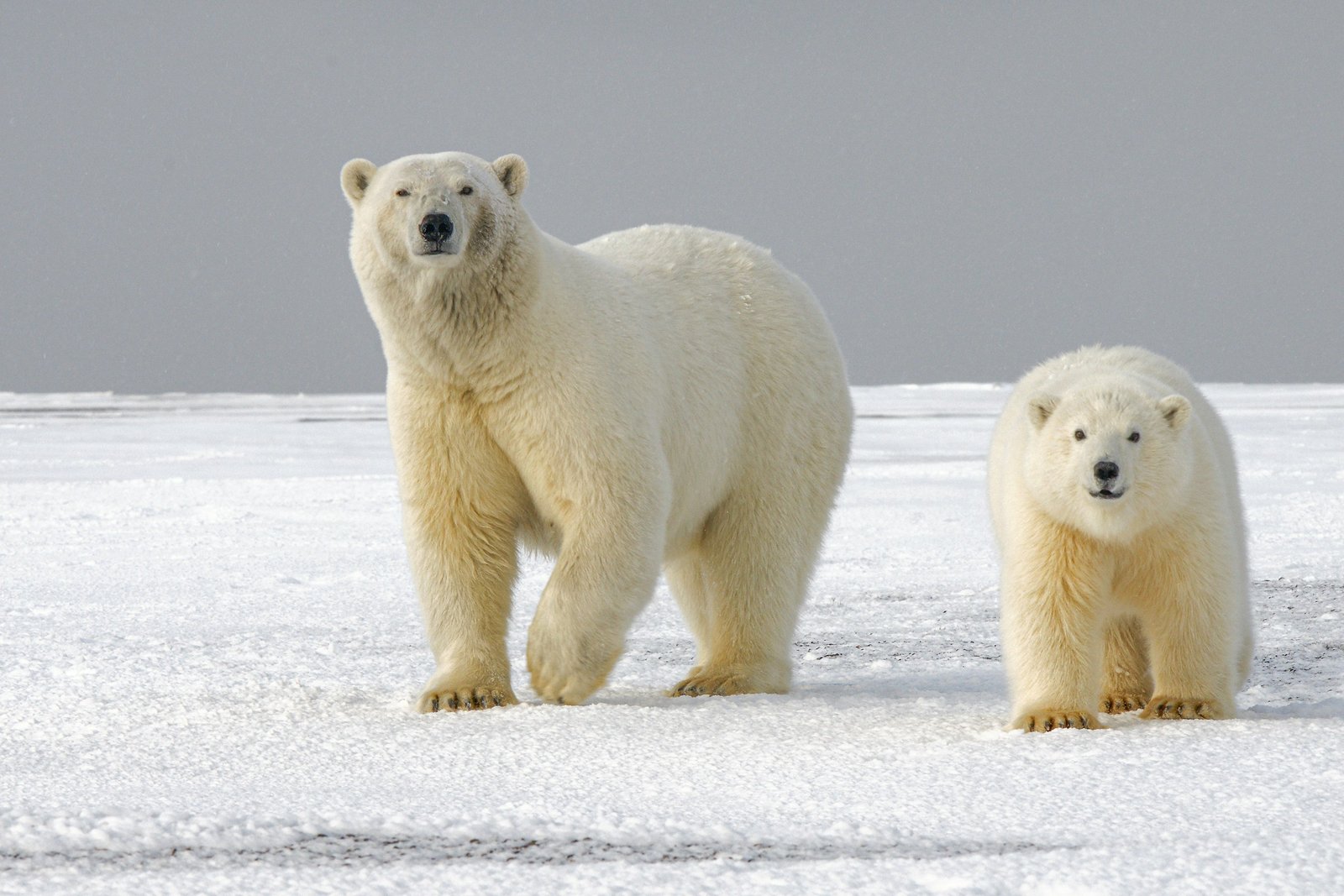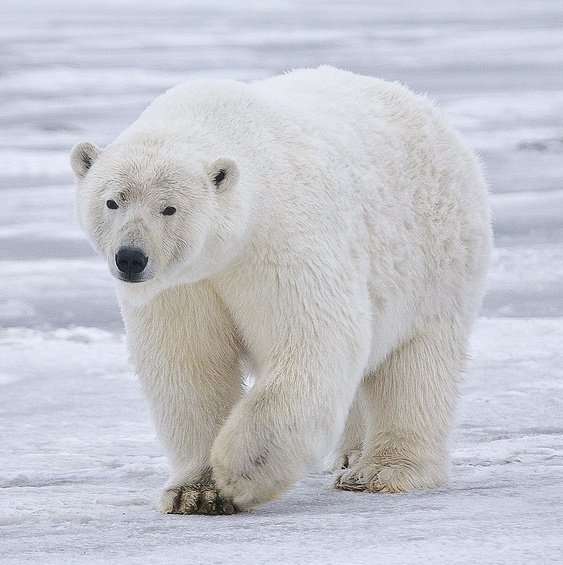
The polar bear (Ursus maritimus) is one of the most remarkable predators of the Arctic. Built for life in an environment dominated by freezing temperatures, sea ice, and long periods of darkness, this powerful bear is closely connected to the marine ecosystem.
Unlike most other bears, polar bears spend much of their lives on sea ice and depend heavily on it to hunt seals. They are considered marine mammals and are among the largest living land carnivores.
Today, the future of polar bears is closely linked to the future of Arctic sea ice. As the Arctic warms and sea ice becomes less available, polar bears can have greater difficulty reaching their primary prey and maintaining the energy they need to survive.
Physical Characteristics
Polar bears have several adaptations that allow them to survive in the extreme Arctic environment.
They have a large body, powerful limbs, broad paws, a short tail and a relatively small head compared with their overall size. Their broad paws help them walk across snow and sea ice and also function as efficient paddles when swimming.
Although polar bears appear white, their skin is actually black. Their fur consists of dense underfur and longer guard hairs that help provide insulation. The hollow appearance of some guard hairs and the reflection of light can make the coat appear white.
A thick layer of body fat provides additional insulation and acts as an important energy reserve. Polar bears can build up substantial fat reserves during periods when food is plentiful.
Their large paws are also equipped with strong claws that help them grip ice and capture prey.
Habitat
Polar bears live throughout the circumpolar Arctic, primarily in areas north of the Arctic Circle.
Their range includes parts of:
- Canada
- Greenland
- Norway
- Russia
- The United States, particularly Alaska
The species is divided into 19 recognized subpopulations across Arctic and sub-Arctic regions.
Diet
Polar bears are primarily carnivorous and have evolved to obtain much of their energy from marine animals.
Their most important prey include:
- Ringed seals
- Bearded seals
- Walruses
- Beluga whales
They may also feed on whale carcasses and other marine mammal remains when available.
Communication
Polar bears communicate through body language, vocalizations and scent.
They may use sounds such as:
- Growls
- Huffs
- Chuffs
- Roars
- Other low-frequency vocalizations
Scent marking also plays a role in communication. Bears can leave scent information as they move through their environment, helping other individuals recognize their presence.
Mothers and cubs have particularly important communication behaviors that help maintain contact and strengthen their bond.
Reproduction and Life Cycle
Polar bears have a relatively slow reproductive rate compared with many smaller mammals.
Females generally reach sexual maturity after several years and give birth to relatively small litters. This slow reproduction means that populations can take a long time to recover from significant declines.
Pregnant females are the only polar bears that normally spend the winter in maternity dens. The mother digs or occupies a den, usually in snow, where she gives birth and cares for her cubs.
Polar bear cubs are born small and vulnerable. They remain with their mother for an extended period while they develop the skills and strength needed to survive independently.
This extended parental care is important because Arctic survival requires considerable experience.
Polar Bear Cubs
Polar bear cubs are born during the winter denning period.
At birth, the cubs are very small compared with their mother and depend completely on her for warmth and nourishment.
The mother remains with the cubs inside the den until they are strong enough to emerge.
After leaving the den, the cubs continue traveling with their mother and learn essential survival skills, including how to move across sea ice and hunt.
The long period of maternal care contributes to the species’ relatively slow population growth.
Population
The global polar bear population is estimated at approximately 26,000 individuals as of 2023, although population estimates vary between regions and individual subpopulations.
Polar bears are distributed across 19 recognized subpopulations, and their status is not identical everywhere. Some populations are considered stable, while others face declines or significant pressures associated with environmental change.
Because polar bears reproduce slowly, sustained population losses can be particularly difficult to reverse.
Conservation Status
The polar bear is classified as Vulnerable on the IUCN Red List. The category indicates that the species faces a high risk of extinction in the wild.
In the United States, polar bears are listed as threatened under the Endangered Species Act.
Conclusion
The polar bear is one of the Arctic’s most specialized and recognizable animals. Its powerful body, excellent swimming ability, thick insulation and remarkable hunting skills allow it to survive in one of Earth’s harshest environments.
However, the polar bear’s greatest strength is also its greatest vulnerability: its dependence on sea ice.
Sea ice provides the platform polar bears need to hunt seals and move through their Arctic habitat. As climate change reduces and alters this habitat, polar bears face increasing challenges in finding food and maintaining healthy populations.
Protecting polar bears therefore requires more than protecting the animals themselves. It requires protecting Arctic ecosystems, reducing greenhouse gas emissions, monitoring polar bear populations and managing human activities in their habitat.
The future of the polar bear is ultimately connected to the future of the Arctic itself.