
Imagine being chased by a dolphin until you become so stressed that you vomit your last meal. Before you can recover, the dolphin quickly eats whatever you have thrown up!
It sounds unbelievable, but researchers have documented this unusual behaviour in a wild bottlenose dolphin nicknamed Bubbles.
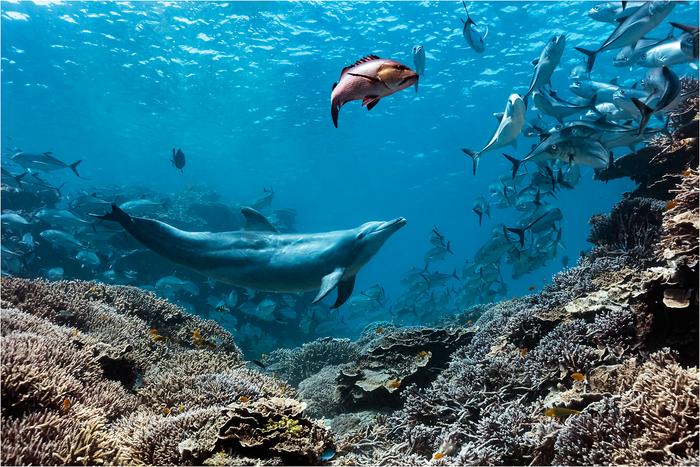
Instead of catching fish directly, Bubbles appears to have developed an unusual feeding strategy: chasing bigeye trevally until they regurgitate their recently eaten food, then eating it himself.
This remarkable discovery offers a fascinating insight into the intelligence and adaptability of dolphins.
Discover more fascinating facts in our complete guide to dolphins and their incredible behaviour.
Who Is Bubbles, the Food-Stealing Dolphin?
Bubbles is a male common bottlenose dolphin (Tursiops truncatus) observed around Lady Elliot Island, near Australia’s Great Barrier Reef.
Researchers became interested in his unusual interactions with schools of bigeye trevally, a species of marine fish.
Rather than attacking and eating these fish, Bubbles repeatedly chased individual fish until they expelled food from their stomachs. He then collected and consumed the discarded meals.
This behaviour was documented over several years, making Bubbles an interesting subject for scientific research.
How Does Bubbles Make Fish Vomit?
Researchers observed a repeated sequence during his feeding sessions:
- Bubbles approaches a school of bigeye trevally.
- He selects an individual fish and begins chasing it.
- The fish eventually regurgitates its recently eaten food.
- Bubbles quickly collects and swallows the expelled material.
- He sometimes repeats the process with another fish.
During one observation, researchers recorded up to 10 chases within approximately 30 minutes.
Also watch this video on youtube channel UniSC: University of the Sunshine Coast
Instead of spending energy catching larger fish, Bubbles appears to take advantage of food that his prey has already swallowed.
The Science Behind This Unusual Behaviour
The research was published on 13 September 2026 in the scientific journal Ecology and Evolution.
The study, titled Repeated Observations Suggesting Kleptoparasitism by a Common Bottlenose Dolphin (Tursiops truncatus) on the Great Barrier Reef, documented 20 foraging observations involving Bubbles.
Researchers recorded 11 successful instances in which he consumed regurgitated food.
They used underwater video recordings and photo-identification to investigate the behaviour and confirm that the same dolphin was involved.
Scientists describe this feeding strategy as kleptoparasitism, which means stealing food obtained or captured by another animal.
This behaviour is also found in other animals. For example, frigatebirds sometimes chase other seabirds until they release their catch, allowing them to steal the meal.
Bubbles appears to use a rather unusual variation of the same strategy.
Can Dolphins Use Echolocation to Find Fish With Full Stomachs?
One fascinating possibility involves dolphin echolocation.
Dolphins produce high-frequency clicking sounds that help them locate prey and understand their underwater surroundings.
During the observed interactions, Bubbles produced clicking sounds before and during his pursuits.
Researchers have suggested that echolocation might help him identify fish that have recently eaten.
However, this remains a hypothesis. Scientists have not demonstrated that dolphins can determine the stomach contents of individual fish using echolocation.
Researchers also do not fully understand why the trevally regurgitate their meals during these encounters. It could be a response to stress or part of a defensive reaction.
Did Bubbles Invent This Hunting Technique?
Scientists still do not know whether Bubbles developed this behaviour independently or learned it from another dolphin.
Bottlenose dolphins are known for their ability to learn specialised feeding techniques.
For example, dolphins in Shark Bay, Australia, use marine sponges as tools to protect their snouts while searching for food on the seafloor.
Some dolphin populations also use coordinated hunting techniques to catch fish more efficiently.
Bubbles’ behaviour raises an interesting question: could this unusual food-stealing technique spread to other dolphins through social learning?
Further research is needed to find out.
What Does This Tell Us About Dolphin Intelligence?
Bubbles demonstrates how flexible dolphin feeding behaviour can be.
Rather than relying exclusively on conventional hunting, he repeatedly takes advantage of an opportunity created by another animal.
His behaviour raises questions about problem-solving, learning and adaptation in marine mammals.
However, scientists have not yet established whether Bubbles deliberately plans these encounters or simply learned to exploit an opportunity during repeated hunting experiences.
Final Thoughts
Bubbles has given scientists another fascinating reason to study dolphin behaviour.
His unusual feeding strategy demonstrates that survival in the ocean is not always about catching prey directly. Sometimes, stealing another animal’s meal can be an effective alternative.
But one question remains: Is Bubbles the only dolphin using this bizarre technique, or are other dolphins secretly doing the same thing?
Future research may reveal even more surprising secrets about the underwater world.