
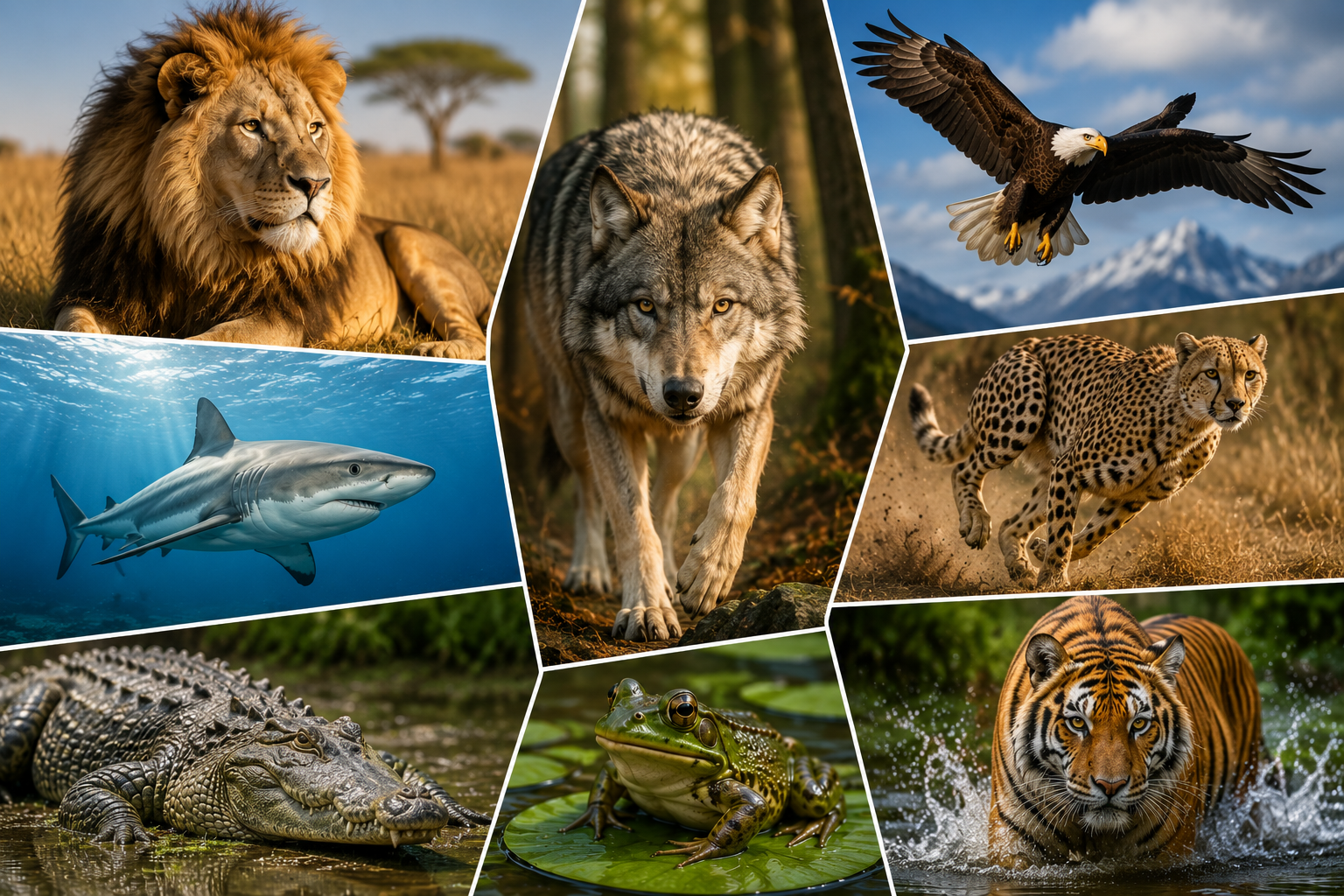
The Siberian tiger, also called the Amur Tiger, is the largest living cat in the world and one of the most iconic predators of Asia.
Appearance
Siberian tigers are adapted to cold climates:
- They have thicker fur than tropical tiger populations.
- Their fur is often paler orange with fewer stripes.
- They carry a layer of fat that helps them survive harsh winters.
- Large paws act somewhat like natural snowshoes.
The Siberian tiger has developed remarkable physical and behavioral adaptations that allow it to survive the harsh conditions of its northern habitat. Learn more about the incredible adaptations that help the Siberian tiger survive the frozen north.
Diet and Hunting
Siberian tigers are apex predators. Their prey includes:
- Deer
- Wild boar
- Elk
- Moose
- Occasionally bears
They hunt mostly alone, relying on stealth and a powerful ambush rather than long chases.
Behavior
- Mostly solitary animals.
- Each tiger maintains a large territory that can cover hundreds of square kilometers.
- They communicate through scent markings, scratches on trees, and vocalizations such as roars and growls.
- Excellent swimmers and capable of crossing rivers.
Population
- The Siberian tiger (Amur tiger) is found mainly in the Russian Far East, particularly the Sikhote-Alin mountain region, with smaller populations in Northeast China and the Russia–China border area.
- In 2005, surveys estimated 331–393 adult and subadult tigers in the Russian Far East, including a breeding adult population of about 250 individuals.
- Following intensive conservation efforts, the population showed signs of recovery. An initial 2015 census estimated 480–540 tigers, including around 100 cubs.
- A subsequent, more detailed census recorded a total of 562 wild Siberian tigers in Russia.
- As of 2014, approximately 35 tigers were estimated to inhabit the international border region between Russia and China.
- By 2022, the Siberian tiger population in the Russian Far East was estimated at approximately 756 individuals, including around 200 cubs.
- Once widespread across the Korean Peninsula, the Siberian tiger was extirpated there during the period of Japanese rule (1910–1945) and is now considered absent from most of its former range.
Body Measurements
| Measurement | Male | Female |
|---|---|---|
| Average Contemporary Weight (2005 study) | 176.4 kg (389 lb) | 117.9 kg (260 lb) |
| Head & Body Length Range | 178–208 cm (70–82 in) | 167–182 cm (66–72 in) |
| Average Head & Body Length | 195 cm (77 in) | 174 cm (69 in) |
| Average Tail Length | 99 cm (39 in) | 91 cm (36 in) |
| Longest Recorded Total Length | 309 cm (122 in) | 270 cm (110 in) |
| Tail Length of Longest Recorded Individual | 101 cm (40 in) | 88 cm (35 in) |
Threats
The main threats to Siberian tigers are poaching, habitat loss and fragmentation caused by deforestation, degradation of Korean pine forests, and climate change, which is expected to exacerbate these existing pressures and increase the species risk of extinction.
Habitat fragmentation and habitat loss
- Research cited in the article identifies habitat fragmentation and loss as one of the two major threats to Siberian tiger conservation.
- Historical deforestation in China, especially during industrial development in the 1950s, significantly reduced tiger habitat.
Hunting and poaching
- Hunting is identified as a major historical cause of tiger decline.
- Although legal protections now exist, illegal hunting continues because of demand for tiger fur and for body parts used in some traditional Chinese medicines.
Loss of Korean pine forests
- Korean pine is important because it provides habitat and supports prey species such as deer and wild boar.
- Increased commercial demand for Korean pine trees threatens these forests and, indirectly, tiger survival.
Climate change
- Climate change negatively affects Korean pine through higher temperatures, reduced precipitation, and increased drought stress.
- Researchers conclude that changing climate conditions are likely to worsen existing habitat-related problems and increase extinction risk.
Declining prey support
- Because Korean pine nuts are a key food source for deer and wild boar (the tiger’s primary prey), degradation of pine forests can indirectly reduce food availability for tigers
Related Species
Read our guide on the Bengal Tiger to discover how it differs from the Siberian tiger in habitat, population size, physical characteristics, and conservation challenges.
Conclusion
The Siberian tiger is the largest tiger subspecies and an important apex predator. Although its population has recovered due to conservation efforts, it still faces threats such as poaching, habitat loss, and climate change. Continued protection is essential to ensure the long-term survival of this endangered species.