
The Bengal tiger (Panthera tigris tigris) is one of the largest and most powerful wild cats, primarily found in India and nearby regions.
Bengal Tiger Range and Distribution
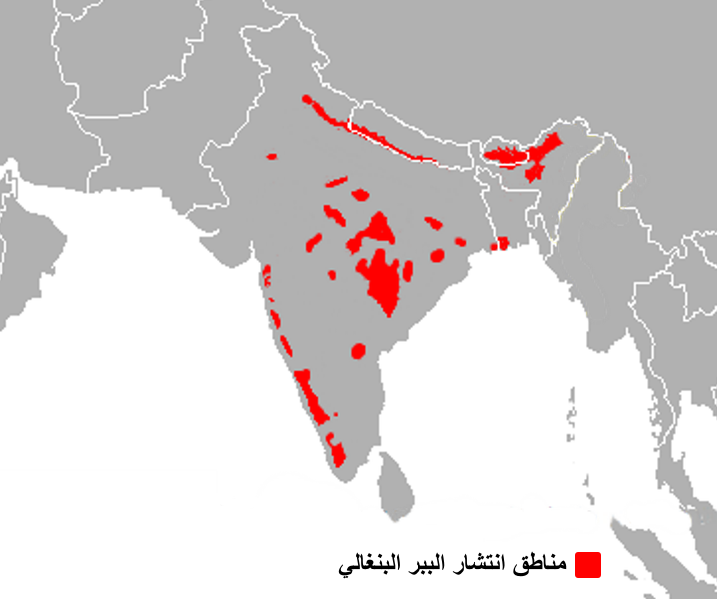
The Bengal tiger is mainly found in:
- India
- Bangladesh
- Nepal
- Bhutan
Bengal Tiger Habitat
Bengal tigers live in a variety of habitats across South Asia. They are commonly found in tropical forests, grasslands, mangrove swamps, and areas with dense vegetation. These habitats provide shelter, access to water, and enough prey for survival.
Most Bengal tigers prefer regions with thick forest cover, where they can remain hidden while resting or moving through their territory. They are also excellent swimmers and are often found near rivers, lakes, and wetlands.
One of the most famous Bengal tiger habitats is the Sundarbans, a vast mangrove forest shared by India and Bangladesh. Unlike other tiger populations, Sundarbans tigers have adapted to a landscape of muddy islands, tidal waterways, and coastal swamps.
Although Bengal tigers can live in different environments, they thrive best in areas that offer abundant prey, reliable water sources, and sufficient space to establish their territories.
Bengal Tiger Appearance
- Orange coat with black stripes
- White underside
- Strong muscular build
- Each tiger has unique stripe patterns
Bengal Tiger Size and Weight
Bengal tigers are among the largest wild cats in the world, although their size varies depending on sex, age, habitat and available food.
Male Bengal tigers are generally larger and heavier than females. Adult males can have powerful muscular bodies designed for hunting and defending their territories, while females are usually smaller and more lightly built.
A Bengal tiger’s body can appear even larger because of its thick fur, muscular shoulders and long tail. Its large paws and strong limbs help it move quietly through forests while also giving it the power needed to overpower large prey.
| Feature | Male Bengal Tiger | Female Bengal Tiger |
|---|---|---|
| Typical body size | Larger and more muscular | Smaller and more slender |
| Weight | Generally heavier | Generally lighter |
| Body length | Longer | Shorter |
| Build | Broad shoulders and powerful muscles | More compact build |
| Main role | Territory and mating competition | Hunting and raising cubs |
Size can vary considerably between individual tigers and different populations, so there is no single size that applies to every Bengal tiger.
Bengal Tiger Diet
The Bengal tiger (Bengal tiger) is a carnivore, meaning it eats meat.
Its diet mainly includes:
- Large mammals such as deer (especially chital and sambar deer), wild boar, and gaur (Indian bison).
- Medium-sized animals like monkeys, porcupines, and hares.
- In some areas, it may hunt livestock such as cattle when wild prey is scarce.
- In the mangrove forests of the Sundarbans, Bengal tigers may also eat fish, crabs, reptiles, and other available animals.
Bengal tigers are powerful ambush predators. They usually stalk their prey quietly and then attack at close range. An adult tiger can consume 15–30 kg (33–66 lb) of meat in a single meal and may feed on a large kill for several days.
Young cubs initially drink their mother’s milk before gradually transitioning to meat brought by the mother.
Bengal Tiger Adaptations
Bengal tigers have developed a combination of physical and behavioral adaptations that help them survive as powerful predators across forests, grasslands and wetlands.
Striped Camouflage
The Bengal tiger’s orange coat and dark vertical stripes provide excellent camouflage. The pattern helps break up the tiger’s outline, making it more difficult for prey to detect it among grasses, bushes, trees and shadows.
Unlike human fingerprints, a tiger’s stripe pattern is unique to the individual. The stripes also appear on the skin beneath the fur.
Powerful Body and Claws
A Bengal tiger has strong muscles in its shoulders, legs and jaws. These physical features allow it to stalk, chase and overpower prey that can be much heavier than itself.
Its retractable claws provide grip while climbing, moving across uneven ground and holding prey. The tiger’s large canine teeth are particularly important for delivering a powerful bite.
Excellent Swimming Ability
Unlike many domestic cats, Bengal tigers are comfortable in water and are strong swimmers. They may cross rivers, swim through wetlands or enter water to cool themselves during hot weather.
This ability is especially useful in regions containing rivers, marshes and wetlands. In the Sundarbans, where waterways divide the landscape, swimming can be an important part of moving through the tiger’s environment.
Strong Senses
Bengal tigers have excellent hearing and vision that help them detect prey and navigate their surroundings. Their night vision is particularly useful because they often become active during the cooler hours of the evening and night.
Their whiskers also provide sensory information about nearby objects and movement, helping the tiger navigate through its environment.
Adaptations for Ambush Hunting
A Bengal tiger does not normally depend on long-distance pursuit to catch prey. Instead, it uses stealth, camouflage and patience.
The tiger can move quietly through vegetation before getting close enough to launch a short and powerful attack. This hunting strategy allows it to conserve energy while taking advantage of its strength and camouflage.
Behavioral Adaptations
Bengal tigers are generally solitary animals and maintain territories that provide access to food, water and suitable shelter. Scent marking, scratching and vocal communication help individuals interact without constantly coming into direct contact.
These behaviors reduce unnecessary encounters and help tigers establish and maintain their territories.
Bengal Tiger Hunting Behavior
Bengal tigers are solitary and highly skilled hunters. They usually hunt alone, relying on stealth, patience, and powerful attacks to catch their prey. Instead of chasing animals over long distances, Bengal tigers quietly stalk their target through dense forests or tall grass before launching a sudden ambush.
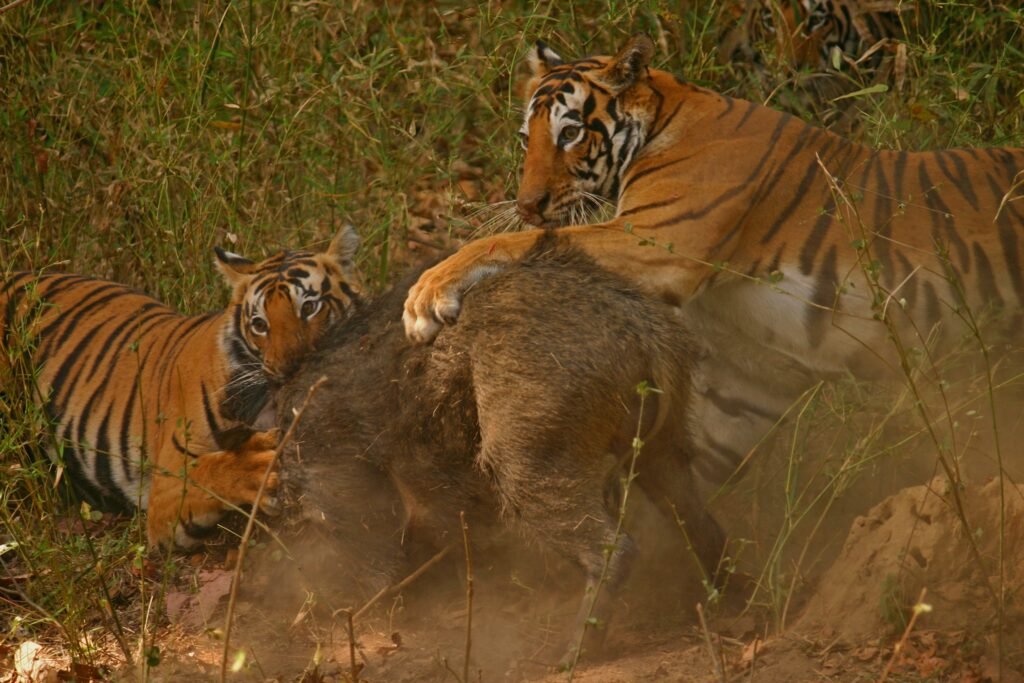
Their diet mainly includes deer, wild boar, buffalo, and other medium to large animals. A Bengal tiger typically attacks by biting the neck or throat of its prey, using its strong jaws and sharp teeth to deliver a fatal bite.
These tigers are most active during the night or early morning, when they can move silently and remain hidden from prey. Their striped fur also helps them blend naturally into forest surroundings, making them effective predators.
Bengal Tiger Swimming Ability
Bengal tigers are excellent swimmers and are considered one of the most water-loving big cats in the world. Unlike many other cats that avoid water, Bengal tigers often swim in rivers, lakes, and wetlands to cool themselves, travel between territories, or hunt prey.
Tigers living in the Sundarbans are especially known for their strong swimming skills. They can swim several kilometers at a time and are capable of crossing wide rivers and mangrove channels with ease.
Young tiger cubs also learn swimming at an early age under the guidance of their mother. Their powerful limbs and muscular bodies make them naturally adapted for moving through water.
Bengal Tiger Reproduction and Cubs
Bengal tigers reproduce throughout the year, although mating and births can vary depending on location and environmental conditions.
Female tigers raise their cubs alone. After a pregnancy lasting roughly three and a half months, a female usually gives birth to a small litter of cubs.
Newborn cubs are extremely vulnerable and depend completely on their mother for food, warmth and protection.
During their first weeks, the cubs remain hidden in a secure den or sheltered location. As they grow, they gradually begin following their mother and observing how she hunts.
Learning to Hunt
Young Bengal tigers learn many survival skills from their mother. They watch her stalk prey, move quietly through vegetation and respond to potential threats.
As the cubs become stronger, they begin practicing hunting behaviors. This learning period is essential because becoming an effective predator requires more than physical strength—it also requires experience.
When Cubs Become Independent
Tiger cubs normally remain with their mother for an extended period while developing their hunting and survival skills. Eventually, they leave to establish territories of their own.
Young females may establish territories relatively close to their mother’s range, while young males often travel farther in search of suitable territory.
Bengal Tiger Conservation and Population Recovery
Tigers moving to higher Himalayan regions
Researchers have reported Bengal tigers being spotted at unusually high altitudes in the Himalayas. Scientists believe habitat pressure, climate change, and shrinking forests are pushing tigers into new territories.
Rare tiger return in Arunachal Pradesh
A Royal Bengal tiger was photographed in Arunachal Pradesh’s D’Ering Memorial Wildlife Sanctuary after nearly 20 years without confirmed evidence. Conservationists are calling it a major ecological success.
The broader landscape had already begun showing encouraging signs of tiger activity. Earlier in January 2026, forest officials from the Jonai forest range in Assam identified pugmarks believed to belong to an adult Royal Bengal tiger in Kobu Chapori, a proposed reserve forest situated near the Assam–Arunachal Pradesh border.
Population Counts by Country
| Country | Estimated Population |
|---|---|
| India | ~3,600–3,700 |
| Bangladesh | ~110–120 |
| Nepal | ~355 |
| Bhutan | ~130 |
| China (very rare) | Few individuals |
Largest Tiger Populations in India
Major tiger states include:
- Madhya Pradesh
- Karnataka
- Uttarakhand
- Maharashtra
Key Facts
- India holds nearly 75–80% of the world’s wild Bengal tiger population.
- The Sundarbans is one of the largest habitats for Bengal tigers.
- Nepal has successfully doubled its tiger population through conservation efforts.
- Bhutan is known for high-altitude tiger habitats in the Himalayas.
Important Tiger Reserves
Some famous tiger habitats are:
- Jim Corbett National Park in India
- Bandhavgarh National Park in India
- Sundarbans National Park in India
- Chitwan National Park in Nepal
Recent Observation: In 2026, a Royal Bengal tiger was photographed by a camera trap in Himachal Pradesh's Paonta Sahib forest range. The sighting highlighted the species' ability to travel long distances through connected forest corridors in search of territory and resources.
Bengal Tiger vs Other Big Cats
The Bengal tiger is one of the largest and most powerful members of the cat family. Unlike cheetahs, which are built primarily for speed, Bengal tigers rely more heavily on strength, stealth and ambush tactics.
Compared with leopards, Bengal tigers are considerably larger and generally capable of taking much larger prey. They also differ from lions in their typical social behavior because adult tigers generally live alone rather than in permanent prides.
Each big cat has evolved different characteristics according to its environment and hunting strategy. The Bengal tiger’s combination of strength, camouflage, swimming ability and stealth makes it particularly well suited to the diverse habitats of South Asia.
Related Species
Read our guide on the Siberian Tiger to discover how it differs from the Bengal Tiger in habitat, population size, physical characteristics, conservation challenges and threats.
Frequently Asked Questions About Bengal Tigers
Are Bengal tigers endangered?
Yes, Bengal tigers are classified as Endangered by the International Union for Conservation of Nature. Their population is threatened by habitat loss, poaching, illegal wildlife trade, and increasing human-wildlife conflict.
How many Bengal tigers are left?
There are an estimated 4,000–4,500 Bengal tigers remaining in the wild worldwide. India alone is home to around 3,600–3,700 wild Bengal tigers, making it the country with the largest tiger population.
Can Bengal tigers swim?
Yes, Bengal tigers are excellent swimmers. Unlike many other big cats, they enjoy water and can swim long distances across rivers, lakes, and mangrove forests. Tigers in the Sundarbans are especially known for their strong swimming abilities.
What do Bengal tigers eat?
Bengal tigers are carnivores and mainly hunt animals such as deer, wild boar, buffalo, and antelope. They are powerful predators that usually hunt alone, often stalking their prey before attacking.
Which country has the most Bengal tigers?
India has the largest population of Bengal tigers in the world, holding nearly 75–80% of the global wild tiger population. Major tiger habitats in India include Jim Corbett National Park, Bandhavgarh National Park, and Sundarbans National Park.
Conclusion
Bengal tigers are among the most powerful and iconic big cats on Earth. Known for their strength, swimming ability, and role as apex predators, they are an important part of Asia’s ecosystems. While conservation efforts have helped increase tiger numbers in some regions, protecting their habitats remains essential for their long-term survival.