
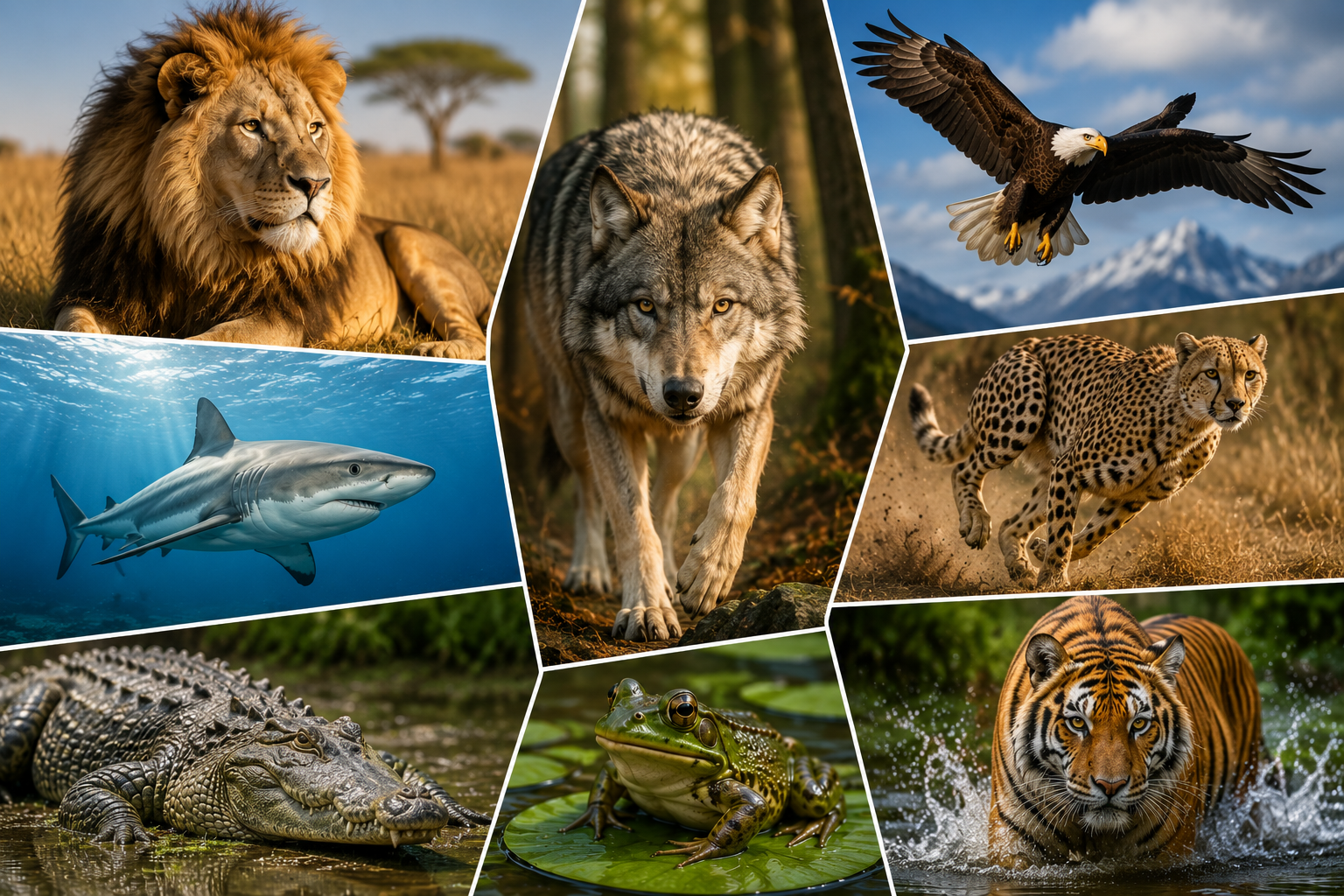
The jaguar is the largest wild cat in the Americas and the third-largest cat species in the world, after the tiger and the lion. Famous for its incredible strength, powerful bite, and beautiful golden coat covered in black rosettes, the jaguar is one of the most effective predators in tropical forests. Unlike many other big cats, jaguars are excellent swimmers and often hunt in rivers, lakes, and wetlands.
Found mainly in Central and South America, jaguars play a crucial role in maintaining healthy ecosystems by controlling prey populations. Their presence is considered a sign of a thriving forest.
Physical Characteristics
Jaguars are heavily built cats with muscular shoulders, broad heads, and short, powerful legs. Their golden-yellow fur is decorated with black rosettes, many of which contain small black spots in the center—a feature that distinguishes them from leopards.
Some jaguars are born with melanism, giving them an almost completely black appearance. Under sunlight, their rosette patterns are still visible.
Distinctive Features
- Powerful jaws capable of crushing turtle shells.
- Broad skull with exceptionally strong bite force.
- Thick muscular body adapted for ambush hunting.
- Excellent swimmers.
- Sharp retractable claws.
- Large paws that provide stability in muddy environments.
Habitat
Jaguar habitats are diverse but are always associated with areas that provide abundant prey and reliable water sources.
Common habitats include:
- Tropical rainforests
- Flooded forests
- Marshes
- Swamps
- Mangrove forests
- Dry forests
- Grasslands
- Riverbanks
The Amazon rainforest contains the world’s largest remaining jaguar population.
Geographic Distribution
Historically, jaguars ranged from the southwestern United States to northern Argentina.
Today they are mainly found in:
- Brazil
- Peru
- Bolivia
- Colombia
- Venezuela
- Ecuador
- Guyana
- Suriname
- Paraguay
- Belize
- Guatemala
- Costa Rica
- Panama
- Southern Mexico
Small populations remain in northern Argentina.
Diet
Jaguars are opportunistic carnivores with one of the widest diets among wild cats.
They hunt more than 85 different animal species.
Common Prey
- Capybaras
- Peccaries
- Deer
- Tapirs
- Armadillos
- Caimans
- Turtles
- Fish
- Monkeys
- Birds
- Iguanas
Unlike most cats, jaguars often kill prey by biting directly through the skull rather than the neck.
Hunting Behavior
Jaguars are solitary ambush predators.
Their hunting strategy involves:
- Moving quietly through dense vegetation.
- Waiting patiently near trails or water.
- Launching a short, explosive attack.
- Delivering a powerful bite to the skull or neck.
- Dragging prey into cover before feeding.
They are active during both day and night depending on prey availability and human disturbance.
Behavior
Jaguar behavior reflects their adaptability and independence.
Social Life
- Mostly solitary.
- Adults meet mainly during breeding.
- Mothers raise cubs alone.
- Males defend larger territories than females.
Communication
Jaguars communicate through:
- Deep roaring calls
- Growls
- Grunts
- Scent marking
- Scratches on trees
- Urine marking
Unlike domestic cats, jaguars are solitary apex predators that rely entirely on hunting for survival. Learn more in our Wild Cats vs Domestic Cats comparison.
Reproduction
Female jaguars can breed throughout the year.
Breeding Facts
- Gestation: approximately 100 days
- Litter size: 1–4 cubs
- Cubs stay with mother: up to 2 years
- Sexual maturity: 2–3 years
Young cubs learn hunting by watching and practicing alongside their mother.
Ecological Importance
Jaguars are apex predators.
They help maintain ecological balance by:
- Regulating herbivore populations.
- Preventing overgrazing.
- Controlling medium-sized predators.
- Supporting biodiversity.
- Indicating healthy forest ecosystems.
Their disappearance can disrupt entire food webs.
Threats
Jaguar populations face several growing challenges.
Major threats include:
- Habitat destruction
- Deforestation
- Agricultural expansion
- Road construction
- Illegal hunting
- Human-wildlife conflict
- Declining prey populations
- Climate change
Fragmented forests isolate populations and reduce genetic diversity.
Conclusion
The jaguar is one of the world’s most remarkable big cats, combining immense strength, stealth, and adaptability. From stalking prey in dense rainforests to swimming across rivers in search of food, this magnificent predator is perfectly suited to life in the wild. Protecting jaguars and their habitats not only ensures the survival of an iconic species but also safeguards some of the planet’s richest and most diverse ecosystems.