
When you hear the words “toothless crocodile”, you might imagine a crocodile with no teeth trying to hunt its prey. But the real story is much more surprising.
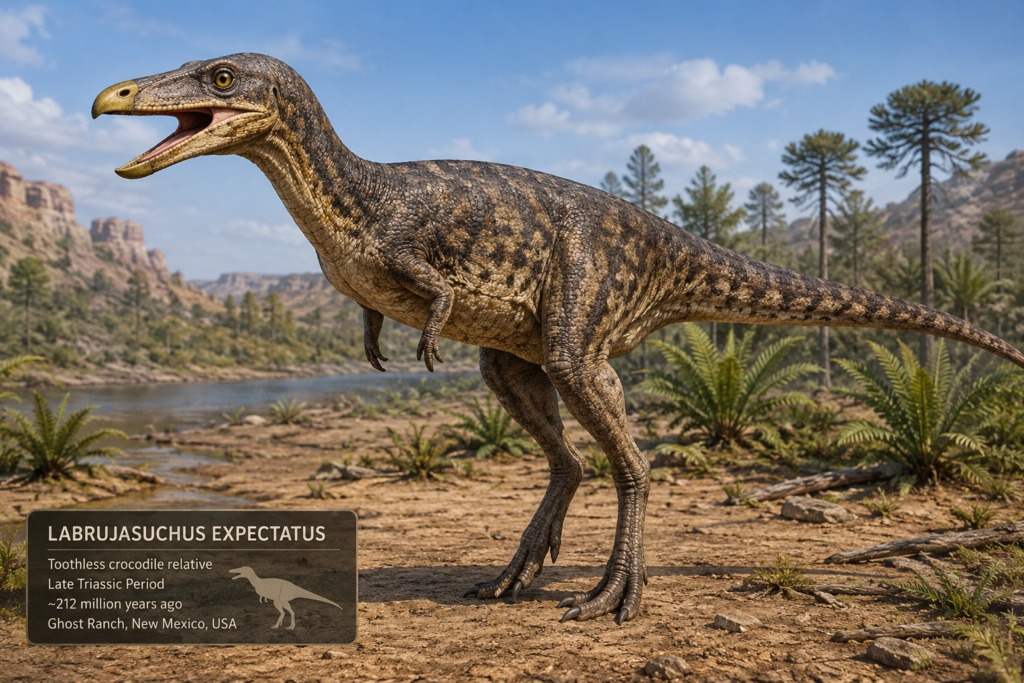
Scientists recently described a bizarre prehistoric reptile called Labrujasuchus expectatus. Although it was related to the ancient lineage that eventually gave rise to crocodiles, it looked very different from the crocodiles we know today. It walked on two legs, had tiny forelimbs, and had a completely toothless, beak-like mouth. It lived roughly 212 million years ago during the Triassic Period.
What Was the Toothless Crocodile?
Labrujasuchus expectatus was not actually a modern crocodile. It was a distant crocodile relative belonging to a group called the shuvosaurs.
Its fossils were discovered at Ghost Ranch in New Mexico, USA, an area famous for its exceptionally rich Triassic fossil deposits.
The animal was described as looking remarkably similar to some later ostrich-like dinosaurs. Unlike modern crocodiles, it moved around on two legs and had a small pair of forelimbs.
Most surprisingly, its mouth was completely toothless and shaped somewhat like a beak.
Was the Toothless Crocodile Dangerous?
Not dangerous to humans in today’s world.
There is an important reason: Labrujasuchus expectatus is extinct.
It lived around 212 million years ago, long before humans appeared. Therefore, there is no possibility of encountering one in a river, lake, swamp, or forest today.
But scientists are still trying to understand exactly how this unusual animal lived.
Because it had a toothless beak-like mouth, it probably had a very different diet and lifestyle from modern crocodiles. Its body shape also suggests that it occupied an ecological role very different from today’s large, four-legged crocodilians.
So, unlike a modern crocodile, this ancient “toothless crocodile” should not be thought of as a dangerous predator of humans.
Why Didn’t It Have Teeth?
This is one of the most interesting questions about Labrujasuchus.
Modern crocodiles have rows of sharp teeth that are extremely useful for grabbing and holding prey. Labrujasuchus, however, evolved a completely different feeding structure.
Instead of teeth, it had a toothless beak-like mouth.
This is a great example of convergent evolution and evolutionary experimentation. During the Triassic Period, many reptiles evolved unusual body shapes and lifestyles. Some crocodile relatives even developed features that made them look surprisingly similar to dinosaurs.
7 Fun Facts About the Toothless Crocodile
1. It wasn’t really a crocodile
Despite its nickname, Labrujasuchus was a crocodile relative, not a modern crocodile species.
It belonged to an ancient branch of the archosaur family tree that was related to the lineage leading toward crocodiles.
2. It walked on two legs
Modern crocodiles are famous for their four-legged body plan. Labrujasuchus was very different.
It walked on two legs, making it look more like a small dinosaur than a crocodile.
3. It had no teeth
Perhaps its strangest feature was its completely toothless mouth.
Its jaws ended in a beak-like structure rather than rows of crocodile-like teeth.
4. It had tiny arms
Its forelimbs were remarkably small compared with its hind limbs, contributing to its unusual dinosaur-like appearance.
5. It lived before the dinosaurs became dominant
Labrujasuchus lived during the Late Triassic, around 212 million years ago.
This was a time when dinosaurs and many other strange reptiles were evolving and competing for different ecological roles.
6. Its name has a fascinating meaning
The genus name Labrujasuchus refers to the old Spanish name associated with Ghost Ranch, “Ranchos de los Brujos,” while suchus comes from a Greek word associated with crocodiles.
The species name expectatus reflects the fact that researchers expected another species to exist between previously known shuvosaur fossils.
7. Scientists have found only a few shuvosaurs
Labrujasuchus expectatus is one of only a small number of known shuvosaur species. Its discovery helps scientists understand how unusual crocodile relatives evolved during the Triassic Period.
Toothless Crocodile vs Modern Crocodile
| Feature | Labrujasuchus expectatus | Modern crocodile |
|---|---|---|
| Lived | About 212 million years ago | Present day |
| Family relationship | Ancient crocodile relative | Modern crocodilian |
| Teeth | Toothless | Numerous teeth |
| Walking style | Two-legged | Four-legged |
| Mouth | Beak-like | Long jaws with teeth |
| Human danger | Extinct | Some species can be extremely dangerous |
| Habitat | Triassic ecosystems | Rivers, wetlands, lakes and other waterways |
Is a Toothless Modern Crocodile Safe?
There is another meaning of “toothless crocodile” that is worth mentioning.
A modern crocodile can lose most or all of its teeth because of age, injury, or other factors. But losing its teeth does not automatically make a crocodile safe.
A large crocodile still has an extremely powerful body, jaws, tail and muscles. Even a crocodile with damaged or missing teeth should never be approached or handled in the wild.
A historical report even documented a large saltwater crocodile with very few teeth that was still capable of causing severe injuries.
Therefore:
Ancient toothless crocodile relative: 🟢 Not dangerous today — it is extinct.
Modern toothless crocodile: 🔴 Still potentially dangerous — never approach it.
The Strange Evolutionary Story
The story of Labrujasuchus expectatus reminds us that evolution does not always follow the paths we expect.
Today, when we think about crocodile relatives, we picture powerful four-legged reptiles with long jaws and sharp teeth. But more than 200 million years ago, some members of this evolutionary lineage looked almost nothing like modern crocodiles.
A two-legged, tiny-armed, toothless, beaked crocodile relative may sound impossible—but the fossil record shows that nature experimented with some truly remarkable body designs.
And that is what makes the toothless crocodile such a fascinating animal from Earth’s ancient past.
Conclusion
The toothless crocodile, Labrujasuchus expectatus, was one of the strangest ancient relatives of modern crocodiles.
It lived about 212 million years ago, walked on two legs, had tiny forelimbs, and possessed a toothless beak-like mouth. It was not a modern crocodile and cannot pose any danger to humans today because it became extinct millions of years before humans appeared.
Its discovery provides another fascinating glimpse into the incredible diversity of reptiles that lived during the Triassic Period.
Nature’s crocodile family was far stranger than we ever imagined!